Total Pageviews

Wednesday, November 28, 2012

"THE EVER-ELUSIVE VICTORY WITHIN"


 "THE EVER-ELUSIVE VICTORY WITHIN"
                                                          by Marianne Williamson

"Our deepest fear is not that we are inadequate.  Our deepest fear is that we are powerful beyond measure.

It is our light not our darkness that most frightens us.  Your playing small does not serve the world.  

There is nothing enlightened about shrinking so that other people won't feel insecure around you. 

 We were all meant to shine as children do.  It is not just in some of us.  

It is in everyone and when we let our own light shine we unconsciously give other people permission to do the same.  

As we are liberated from our own fear, our presence automatically liberates others."


Tuesday, November 6, 2012

POLLEY'S PERCH (Prairie Reef Lookout)


        POLLEY”S PERCH
         (Prairie Reef Lookout)


I don’t know how to begin to tell you what it is like to be stationed at a remote fire lookout deep in the wilderness for nearly eighty days by yourself.  The experience is beyond words but resonates deep imprints upon my imagination, dreams and every cell in my being.  It was truly amazing!  The sunsets, the sunrises, the storms, the clouds actions, the wildlife, the visitors, the vast starry night were all glorious, but I also don’t want to romanticize the experience too much because it wasn’t all peaches and cream, all day, everyday.  In fact, it was difficult at times.


There were days on end where the visitors did not show their face walking and struggling up the steep trail or riding their horses that stunk of must and lathered up from sweat and reeking of wet leather.  Days where I struggled to be alone dealing with the demons (not literally for you literalists) that rise up from the abyss that anyone knows who has been alone for a long time and begins to take themselves too seriously.  I was forced to live in the moment because there was not a damn thing I could do about my future.  I was drunk on sunsets and sunrises. Other days and moments of days where I was giddy dancing around the lookout with music and drink watching the sunset or being amazed by something life offered out of the big screen, seventeen windows on surround-sound at 8,868 ft above sea level.  


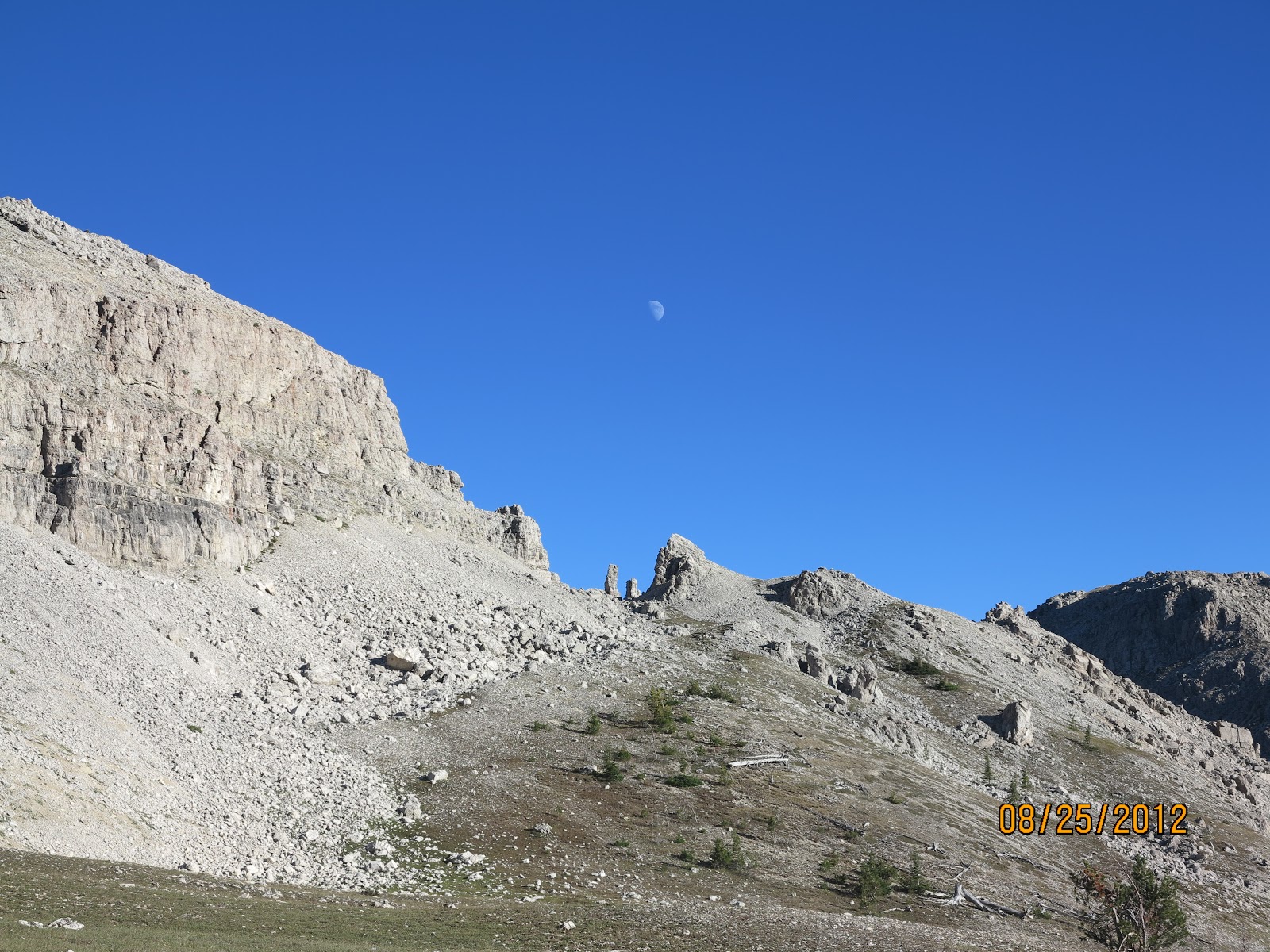
Wave after rippling wave of mountains loomed in my vision like a ship on the water; the lookout looked out over a vast ancient ocean.  My writing desk/kitchen table sat facing the entire length of the infamous “Chinese Wall”.  A vast limestone reef that stretches along the continental divide for seventeen to twenty-six miles depending on what source you read.   On a clear day I could see one-hundred and twenty miles due west all the way to the Cabinet Mountains which separate Montana from Idaho.  I stared out at McDonald Peak as it towers above the Mission Range fifty miles away.  Holland Peak and Swan peak in the Swan Range, Silvertip mountain near Spotted Bear,  the Great Northern with its shark fins rippling and tearing the sky fabric, many peaks of Glacier National Park like Jackson, Stimson, Mt. Siyeh, Battlement, Doody and St. Nicholas, which looks like a middle finger spinning the sky on its finger tip.  Nine different mountain ranges and over three hundred peaks scattering and smattering my vision.  I (eye) was just another mountain in a sea of mountains.  I felt like part of the mountain.  My phenology or sense of place grew and became in tune where I would have an intuition to look up at the right time and feel an animal of sorts was walking on a part of me.


I hate to make lists and read them for the boredom it inspires but here is just a few of the other names of landmarks that the names speak for themselves and conjure up images in the imagination like; Woodtick Mtn, Jumbo, Fisher Pk, Flathead Alps, Red Butte, White River Pass, Grizzly Basin, Chinese Wall, Sphinx Mtn, Mocassin Butte, Cliff Mountain, Damnation Creek, Moose Creek, Larch Hill Pass, Pentagon, Table Mountain, Slategoat Mtn, Wrong Creek, Old Baldy, Rocky Mountain, Mt. Wright, Sheep Mtn, Ear Mtn, Arsenic Ridge, Castle Reef, Sawtooth Ridge,Windfall Creek, Crown Mtn, Renshaw Mtn, Scapegoat plateau and mtn, Sugarloaf Mtn, Scarlet Mtn, Twin Peaks, Bumshot Mtn, Bunyan Point, No Business Creek, Nome Point, White Ridge, Whiskey Creek, Cigarette Rock, Hermit Lake, White Bear Creek, Black Bear Creek, Grizzly Gulch, Scarface peak, Indian point, Feather Woman peak, Badger Two-Medicine, Solitude Point, Two Shacks Flat, Big Salmon Lake, Devils Creek, Devils Hump, Teton River, Sober Up Creek, Fiction Creek and Two Medicine River.  All of these places and place names describe what took place here in the not too distant pass.  Each name strikes up something in the imagination.  These places were my neighbors and inspiration for an entire two and half months and I am very thankful.

Fire Lookout like a nipple on a very large rocky breast


I had over one-hundred and fifty visitors come up to the lookout for the views.  In fact it is one of the most popular places in the Bob Marshall Wilderness Complex.  “Prairie Reef is the creme de crop of the fire lookouts”, one local outfitter told me. It is the highest lookout in the whole state.  


Grizzly Sow and Cub


The Bob Marshall Wilderness Complex is one and a half million acres and is larger than Glacier National Park.  It is eighty miles long and over thirty miles wide.  It has one of the largest big horn sheep populations and one of the largest elk herds in the lower forty-eight.  It screams of wildness with all of the species minus bison still remaining here since the time of Lewis and Clark and they tried to find a passage through these mountains.  Mountain Goats and big horn sheep would come by my office once a week.  Golden Eagles and Prairie Falcons soared by my windows each day.  Grizzly and Black Bears were spotted from my perch.  I saw one to sixty head of elk grazing the high alpine meadows with their lush green grasses everyday.  Mountain lions stalked hoary marmots and other creatures in the shadows along cliffs in the dusk and dawn.  Even a wolverine was seen loping down the trail.  I briefly saw it, but I did see its tracks on many other occasions.


Russell Owen and Joe Woodhead lead mule pack string up to bring me supplies

My food, water, mail, propane and building supplies were brought up on horseback once every three weeks by my boss or our packer.  Having mail delivered just to ‘you’ over fifteen miles back was like Christmas; opening gifts, letters and cards reading loving thoughts and inspiration from afar but not so far bringing friends and loved ones to your door in spirit and word.  I did not have a cell phone, internet or luxury of running water; everything was narrowed down to the bare essentials of life.  As Jim Harrison writes, “. . . avoid the junk of our culture. . . it is hard enough to live with what we know without drowning in this junk.”  I am not anti-technology.  It does have its place just as long as it doesn’t rule our lives.

As the author and a previous fire lookout Norman MacClean writes, “It does not take much in the way of body and mind to be a lookout, its mostly soul.”  It is not a vocation for most people and in fact it takes a special breed of person to want to do it and do it and not go crazy.  One has to master the art of solitude because it like an extended vision quest.  One is solitary, but not alone and has to learn to be thrifty and self-sufficient.  The animals, birds, plants and insects were there all the time and imbued with sentience and consciousness some call it “GOD” so I was not alone.  Everything was constantly changing; clouds, animals coming into view, visitors, sunsets and sunrises and mountains slowly crumbling to the sea and your thoughts were like the weather breezing in and out of you.  Everything was so alive and vibrant.  I wasn’t alone.  Time spent being a lookout isn’t spent at all.  Everyday in a lookout is a day not subtracted from the sum of one’s life.

           Each day I would wake around sunrise or before and start my day.  When you are surrounded by windows you are effected by the light and the weather.   As I made coffee on my propane stove I would scan the surrounding landscape for smoke or fires and wildlife.  Then I would start off my day reading poetry still scanning landscape for fire and wildlife.  Then between seven and eight people in the field like rangers, trail crew, Bear DNA people, and others would check in with us to let us know what they were doing that day and where they were going.  We would write it down in a journal and the time to make sure they checked in at night or start a SAR (search and rescue) for the missing person(s).  Then at ten and fourteen hundred we would take weather observations and log it.  We checked the wet and dry bulb temperatures on a psychrometer and subtract the two to get relative humidity.  Then we would check wind speeds via a kestrel weather device.  I would also check cloud or smoke  visibility and figure out percentage of cloud cover and check rain gauge.  We were not required to radio this  in like other lookouts for other forests or the park service unless there was a fire within our vicinity and you record the weather on the hour every hour to predict fire behavior for the firefighters on the ground and in the air.  Other than relay messages and weather observations each day I was required to do building maintenance and the rest of the day was mine to do what I willed.  I had the most freedom I have ever had with any job.  It was better when I had projects to do or took advantage of my time otherwise the amount of minutes and seconds in a day is quite overwhelming and daunting.  "May I enjoy this beauty and solitude in this place of timeless wonder."


Drawing I did this summer of Cliffs of Moore in Ireland


Kyle Scharfe

friend Heidi on a spaceship (a cabin wrapped to save from wildfire)


"Chuck"  Charlie Speicher


Christopher "Lewis" making yerba mate in a Argentina bombilla (gourd)

Jammin and Ziggy (Jon Ziegler)


Joanna and Carrie


Prairie Reef Pirates
"Arrggh Land ahoy mate'!"


   I had many of my great and wonderful friends come up for a night or many nights and we had mad and wild fun sharing laughs, drinks and meals.  It was wonderful! I wish I could have brought all my friends up for a night to to see the beauty and discuss what the wildness means to them.  I read over twenty books from “Lonesome Dove” by Larry McMurtry to “Sometimes a Great Notion” by Ken Kesey to Stephen King’s “On Writing”; A Memoir of the Craft” to Cormac McCarthy “All the Pretty Horses” to Jim Harrison “Returning to Earth” to John Steinbeck’s “Grapes of Wrath” and to Phillip Connors “Fire Season”: Field Notes from a Wilderness Lookout to several poetry books.  Sure, I have read many of these books before but it was nice to revisit them and ruminate on the words of wisdom.  I drew a new drawing of a postcard my friends Brian and Morgan sent to me from Ireland of the Cliffs of Moore.  Also I did several building projects from scraping paint off ceiling to re-painting it, splitting wood, tore apart old stairs and built new ones and tore off old wood siding and put up cement board because rodents (marmots, pack rats and mice were trying to get into lookout and several suceeded.


      More updated blogs and pictures to come

Saturday, October 20, 2012

An article a friend wrote about visiting me in this cabin I stay at in a local magazine


Finding Kishenehn 

A remote trail through Glacier's forgotten corner leads to its northernmost ranger station and a lost era

November's wan light drained from the sky as I walked alone into a forgotten corner of Glacier National Park. As night grew from the shadows, noises in the forest grew louder. My head jerked at the sound of a branch brushing my pants. A foot of fresh snow obscured the tracks of an oversized carnivore on the trail that led me into dark timber. Everywhere was blackness, the world reduced to my headlamp’s bobbing orb of light. It seemed inevitable it would suddenly be filled by some variety of toothy creature.
I checked the pepper spray canister in my pack’s side pocket. Then I remembered the propellant in pepper spray doesn't work in temperatures below freezing. It was 20 degrees.
"Well, this is exciting," I thought to myself.
click to enlargeMontana Headwall - Outdoor adventure under the big sky
I’d gotten a late start but was determined to reach the old Kishenehn ranger cabin where my friend Benjamin Polley was waiting. Though I’d navigated the faint trail many times, the deepening snow made route-finding a challenge. By the time I reached Kishenehn Creek its icy flow was being swallowed by the night and thickly falling snowflakes clouded my headlamp beam. I took a moment to steel myself and then forded. But in the chaos of snow and darkness, I picked the wrong spot and couldn’t find the trail on the other side.
This was the point at which I became quasi-lost. Not lost-lost, mind you—I knew where I was, more or less. But I had no trail and the darkness was closing in around me. As I bushwhacked through the black unknown an owl took flight from the night and took a couple of my heartbeats with it.
I was reminded of the writer who said fear is an essential part of the wilderness experience. This is why I come here to this unruly, forgotten forest in the far northwest corner of Glacier. To be wild again, the way we used to be.
The night before, as I lay in bed in the civilized confines of Missoula, I thought about how I would be completely off the human grid on this hike—no phone, no people, no contact with the modern world—and how rare that’s become. I like that feeling. With no safety net between myself and the wild, everything seems more alive.
The first time I attempted this trail was over a decade ago, after discovering it on a yellowing map that showed it leading to a mysterious ranger station. Current park maps show no trails or ranger stations here, and it felt like I was the first person in years to follow the indistinct path. Eventually I reached that same Kishenehn Creek crossing where the trail simply disappeared. At the time, I figured that was it—the area had been abandoned to wilderness.
Five years ago I learned this was only partly true. The area had indeed returned to wilderness, if it had ever been anything else, but the Kishenehn Ranger Station was still there, hidden in thick timber near the North Fork of the Flathead River. More importantly, my friend Ben, a longtime park employee, had been invited to man it during hunting season. His job was to patrol for poachers, the original reason this outpost is here at all.
The first cabin was built at Kishenehn in 1913, three years after Glacier's creation, as the northernmost link in a chain of log-cabin ranger stations encircling the park. A wilderness park where nature had primacy was a new concept, and park managers wanted to shield it from neighboring homesteaders who bristled at the notion of a place where they couldn’t hunt, trap, graze and log. To protect it, the Kishenehn ranger was tasked with patrolling the area’s scattering of trails.
Local residents eventually accepted the park, but tourists never arrived at Kishenehn due to its inaccessible location, lack of amenities and mountain-obscuring forest, and the rangers were removed. Except for rare visits by rangers or wildlife researchers, the cabin, woodshed, and log barn sat unused for decades, vestiges of a lost era.
But the modern-day threat of poachers lives on, and Ben now hikes here every fall. For each of the last five years I’ve come to visit, always on the cusp of winter when the air is bracing and larch needles turn to gold. I don’t come for the views, I come to recalibrate and feel the rhythms of the wilderness. I’m a sucker for knock-you-upside-the-head grandeur as much as the next guy, but over the years I’ve learned to prefer slightly less spectacular places with wilder character, where the animals don’t come for handouts, they come for prey. That’s Kishenehn.
click to enlargeMontana Headwall - Outdoor adventure under the big sky
In the farthest reaches of the North Fork Valley, 13 miles of ragged dirt road north of Polebridge, itself some 30 miles of rough road north of Columbia Falls, there is an unmarked trailhead. Beyond this entry point lies a land of primitive trails, towering forests and wildlife beyond counting. A literal blank spot on the map, here in a corner of one of America’s showpiece national parks is a place virtually nobody goes. When Ben and I are hiking in together, we invariably go quiet after the first mile or so as the Kishenehn acclimation begins. The call of ravens and the jackhammer of pileated woodpeckers replace our conversation. We share a love of tracking wild animals and there are always tracks upon tracks of elk, moose, wolf, lion, grizzly. Then maybe a tuft of hair. Then a hoof, the toes of a deer, lying on the ground like a discarded toy. Inevitably, the carcass parade begins. We gather around the tracks, prod and smell the scat, excitedly studying the kill sites like young boys at Christmas.
The trail here is more like a game trail than the park’s well-pounded expressways, and after five miles it disappears in the cobble along Kishenehn Creek. My first trip in, Ben showed me where to pick up the faint trail to the ranger cabin on the far side. Fording the creek—never deep, always cold—is like crossing a border into the wild heart of Kishenehn. The trees are bigger, the beaver ponds never-ending, and the trail paved with lion and wolf scat. Besides Ben and our friends, I’ve never seen another person here.
We always come with good boots, good books, and good wine. Sometimes we take a day in the cabin to drink tea and read, and Ben, who vows to someday write a book about this place, pens epic paeans in the station’s logbook, which is otherwise filled with taciturn ranger entries. But most often, like those early patrolling rangers, our days revolve around movement.
A hike we took one cold, cloudy November day perfectly illustrates the Kishenehn experience.
The howling of wolves woke us at sunrise. In less than an hour we were stepping out of the cabin’s grizzly-proof, metal-grate front door with a day’s provisions in our packs. Not more than 200 yards from the cabin were lion tracks, fresh on the morning’s dusting of snow (there’s nothing better here than a fresh dusting of snow). Ben and I high-fived. A lion—a lion!—had just been here. As we followed its tracks down the trail, wolves howled in the distance. We followed the old Kootenai Indian trail up Kishenehn Creek through a towering forest of old-growth larch and fir and aspen tattooed by bear claws.
At the antler- and skull-littered meadows near the Canadian border, we sat and ate in silence. But Kishenehn sang as chickadees filled the air with good cheer and wedges of geese flew overhead in jumbled, bicycle-horn symphonies. Later we saw the tracks of a wolf that had come to the meadow’s edge, seen or heard or smelled us, and turned away.
On our way back at the end of the day, we split up for the last two miles and I explored off-trail in the encroaching shadows. Grizzly tracks appeared just before I reached the cabin. Had it gone before Ben or after him? Following the tracks by headlamp led me directly to the cabin.
Ben was standing on the porch and announced, “This griz came right up to the cabin, with smoke coming out of the chimney, smelled our pee, and then flipped over the pack rat we threw out and kept going up the river trail—where we’re going tomorrow.”
The lesson here is that while the big carnivores won’t cavalcade in front of you in Kishenehn’s old forest like they might in, say, Yellowstone, there’s no question they’re here. The other lesson is that if you trap a pack rat and toss its carcass in front of the cabin to see what will come eat it, you don’t have to worry about it being a grizzly bear.
click to enlargeMontana Headwall - Outdoor adventure under the big sky
Sometimes the wildlife encounters here are less oblique. Consider the time we were walking along the border swath, that 40-foot-wide treeless line in the sand our country maintains up and down mountainsides for reasons only bureaucrats can understand. Ben was walking a short distance ahead of me as I snapped pictures. Then the ravens appeared, circling loudly over Sage Creek. We immediately squatted down and watched. We suspected a kill site, but we couldn’t see down into the creek bottom.
As I stalked my way toward the bank behind Ben, he came speed-walking back to me furiously waving his hands. I’d never seen him so rattled. Quietly but with a fierce urgency he said, “Go, go, go! There’s a huge black grizzly bear on an elk carcass in the creek bottom.”
He was terrified in a way only someone who has just seen a murderous grizzly at close range can be. It hadn’t seen him, he said, but it was swinging its snout from side to side trying to sniff out the intruder it knew was there. We had to leave, he said, now.
Some people say the value of large predators is that they teach us humility. At this moment Ben was a spouting fountain of humility. Clearly this was more of a wilderness experience than he was looking for.
I, on other hand, desperately wanted to see this bear. How many opportunities do you get in a life to see a huge black grizzly bear standing on an elk carcass? All I had to do was creep to the edge of the bank, look down 30 feet, and boom: bear sighting of a lifetime. The wildest of the wild was within my grasp.
click to enlargeMontana Headwall - Outdoor adventure under the big sky
But what if I reached the bank and the bruin was right there, climbing up after our scent? I have kids. I didn’t want to die here in this stupid swath. So after a few moments of contemplation, I reluctantly turned around and we trudged the eight miles through a foot of snow back to the cabin.
While every day in the teeming lands around Kishenehn carries the unpredictable, kinetic hum of a self-willed landscape, for every dramatic encounter there are five days filled with the kind of dynamic calm that only deep wilderness provides. Often we simply tromp to the nearby beaver kingdom, where the impossibly industrious rodents have dammed the spring that is also our water source. Their concentric dams create a terraced series of pools reminiscent of Asian rice paddies. They’ve also engineered a network of deeply worn, four-foot-wide channels through the surrounding spruce forest.
All of it—the countless dams, their Mount Rainier lodges, the snaking, grassy-banked channels—suggests an ancient beaver civilization. For untold centuries they’ve been building their beaver world here, unmolested in the farthest reaches of Kishenehn.
Whether we’re contemplating beaver kingdoms, tracking lions­ or dodging grizzlies, Kishenehn is always an adventure—but never more so than that night of the November blizzard when I lost the trail. As I felt my way through the snowy darkness beyond Kishenehn Creek, I eventually reached the bank of the North Fork where fresh pieces of ice flowed past my headlamp beam. Cold crept under my jacket and I contemplated the possibility of bedding down for a frigid night in my emergency bivy.
There was a faint ambient light from the moon above the storm clouds, above the troubles and life-and-death struggles of our world. You couldn’t really see things, but more sense their impressions. Then, somehow, I recognized the silhouette of a cluster of cottonwoods along the river. At that moment I knew I’d almost reached the cabin. Something about recognizing those trees in the night also showed me that in some small way I’d become a part of this place, that my story was now woven into the wild fabric of the landscape here.
click to enlargeMontana Headwall - Outdoor adventure under the big sky
For millennia we humans lived in untamed, natural places like this. Until recent times, we were a part of the wilderness. We may not realize it, but its rhythms are still our rhythms, its wildness is still our wildness. We feel it when we return to places like this. Something relaxes, something is attuned, something comes alive. We’re home.
Ben wasn’t at the cabin when I finally reached it. He was out looking for me, afraid I’d fallen in a creek or the belly of a grizzly. He’d found my tracks though, right after the tracks of a wolf that had suddenly turned around, likely when it heard me—the creature I was waiting for in my light beam. We told stories of searching and being lost far into the night over mugs of hot tea by the woodstove. Dark, snowy hikes aside, or maybe because of them, it was good to be back at Kishenehn.

Monday, April 16, 2012

WOLVERINE STUDY


A few weeks ago, one of my friends and I skied into Kintla Lake in the North Fork Valley of Glacier National Park to help with an ongoing wolverine study.  Researchers and biologists are trying to get a population estimate of the number of wolverines who call Glacier their home.  Wolverines are the largest member of the weasel family.  They range in weight from thirty-five pounds in the lower forty-eight to forty-five pounds in Alaska and the far northern reaches of Canada.  They are a very elusive animal, which not much is known about their daily lives and habits.


This study has been going on for nearly a decade and researchers started out setting these log cabin like wooden traps in the back country of Glacier with frozen dead beavers placed inside to lure wolverines into them.  As soon as the wolverine would come into them a trap door would close locking them in.  Researchers were alerted when this happened, so they could get there as fast as possible by cross-country skiing into these places with a veterinarian named Dan Savage, which then they would tranquilize the wolverine and surgically implant a GPS unit inside the wolverines.  If the biologists don't get in there quick enough wolverines will eat and tear their way out with their razor like claws and powerful jaws known to crush through bones.  Wildlife biologists have tried all kinds of methods tracking and radio collaring wolverines, but wolverines have such a huge neck that they can take the radio collars off by sliding and slipping them over their heads.  The research being done is ground-breaking research of an animal that biologists know little about.

They are known to drive grizzly bears and other animals off of their kills and are known to be a fearless creature that dens in the alpine and is known to climb mountains in the park in record breaking time and up routes that climbers have tried to replicate and were turned back from.  A wolverine known as M3 climbed up Mt. Cleveland, the highest peak in Glacier National Park at 10,466 ft, in the dead of winter in an hour and half.


After a couple of years of catching and trapping wolverines now the last couple of years researchers and volunteers such as myself have been volunteering their time to ski into remote places in the park in several drainages to set up ten foot posts that we stand erect and we lag bolt front quarters of deer legs (that we find outside the park), to the tops of these posts then we screw in twelve wire-mesh gun cleaning brushes along this post to snag wolverine hair as the skunk bear (wolverine) climbs these posts to get to the legs.  We also wipe animal lure consisting of beaver castor oil and skunk glands underneath the frozen deer legs to attract the wily critter.  Through this study they have estimated about 40-50 wolverines calling Glacier their home.  Unfortunately, the state of Montana still allows the trapping of four wolverines a year throughout the state and they have no idea of how many live in the state.  They only live in  a few remote biological islands (areas set aside as wilderness areas and national parks).


My friend and I skied into Kintla for three days and two nights.  The first day in there the sky was a gun-metal steely gray day with clouds hanging low enveloping mountain summits with the occasional glimpse of the white snow covered icy tops.  We skied in there March 24-26 half expecting to catch a glimpse of the legendary grizzlies who sometimes stay up all winter competing with lions and wolves for their kills.  On our ski in there we did not see many tracks at all of much life until about a mile below the foot of lower Kintla Lake where we came across numerous fresh wolf tracks tattooing the fresh coat of three foot deep snow.


Snowshoe hare, whitetail deer and elk tracks also graced the snow covered road we were skiing upon.  We pursued canus lupus (wolf) tracks to the foot of the lake and skied over to the post at the dock and noticed no carnivore hair on the brushes, but looked as if down feathers from eagle and ravens on the top brush.  They were landing on the deer leg and pecking away at the flesh and ate most of the meat.  We took down the post and bolted another fresh deer leg to the post and then began skiing across the lake.  At first we were little bit sketched about skiing across the lake due to the warming temperatures haunting the lower valleys this winter.  We found it was sturdy enough to ski across but we only decided to after noticing other animals dotting the snow across the thin veneer of snow covering the lake.


We skied the five and half miles across the lake and were happy for this opportunity to ski it because if the lake is not frozen, one has to walk along the trail the seven miles to the head of the lake to the cabin because a rain/snow shadow that is cast over the western shore reveals a diaphanous amount of snow that is just a dusting creating a perfect wintering range for numerous animals.  Kintla Lake is one of my favorite places to go to in the winter because of this weird weather phenomena attracting me like a long lost lover year after year that calls me back like a salmon going back to its birthing grounds.  A few carcasses coated the snow copper with dried blood, deer hair and bones scattered on the lake ice.


We woke to lake ice communicating in a strange archaic language older than words as the spirit of the lake reverberated and echoed inward and outward as the lake ice thickened.  The next day was a brilliant bright bluebird day with temperatures rising into the sixties.  Avalanches thundered off of Long-Knife Mountain throughout the day sending warnings to animals on the slopes or in the path of the white freight train.  After a casual morning of eating a nice breakfast and drinking coffee we hiked to the Upper Kintla Lake.  We were not able to ski up there because the rain/snow shadow casts its mark all the way to the upper lake and only a dusting of snow lined the trail.  Fresh giant grizzly tracks met us in the snow about a hundred yards behind the cabin.  By mid-afternoon we were stripping off clothes and walking around in tee-shirts and shorts and boots.  Our skin was soaking up the much needed vitamin D as we basked in the sun taking our time and enjoying the feeling of being so remote.


The griz tracks followed the trail most of the two point three miles to the foot of the Upper Lake.  The griz tracks were probably from the night before or the day before.  The bear probably just woke up from hibernation and might not be to excited about meeting us and might be terribly hungry.  Numerous deer and elk tracks also dotted the snowy trail besides the G bear tracks.  We were both surprised that we did not see any wolf tracks between the two lakes.  Mountain lion tracks were noticed in the avalanche chute coming off Long-Knife Mountain at Long Knife Creek.


We found the post in the avalanche chute after searching for it for over two hours.  The post was on the ground the meat was gone and what looked like wolverine hair or bear hair was all over the brushes.  Whatever animal it was knocked the post over and took every last bit of it meat and bone away.  That was one of the most glorious days I have had back there as far as warm temperatures in the five winters I have skied back there.  The next day greeted us with warm temperatures and a glacier gray day hung over the valley with a slight mist falling from the sky.  I found griz tracks down by the lake shore the next morning that were not there the day before.  We also followed griz tracks along the eastern shore over half way down the lake that were not there two days before when we skied in.